Form Follows Function.
Function Follows Context.
The best solutions don't feel designed. They feel inevitable. You recognize them immediately — not because they are familiar but because they are precisely right. They belong to their moment. They fit their market. They reflect the organization that made them. Nothing about them is arbitrary.
That precision is not intuition. It is not talent. It is the result of a discipline that begins long before a concept is conceived — the discipline of understanding the full structure of the situation before attempting to shape it.
The familiar phrase form follows function has guided designers for more than a century. It suggests that the shape of an object should emerge from what that object needs to do. Chairs support the body. Buildings provide shelter. Tools extend human capability. Yet function itself does not exist in isolation. What something must do is always determined by the conditions in which it operates. A wing functions differently in dense air than it would in thin atmosphere. A boat designed for calm lakes would fail in open ocean.
Function, therefore, is not abstract. It is defined by context. Seen this way, design becomes less about inventing solutions and more about understanding the structure of the situation that produces them. When that structure is understood clearly enough, the right solution begins to reveal itself.
In many ways this structure resembles code. Just as software code defines the behavior of a program before the program is executed, the surrounding conditions of a problem define the functional requirements that shape its eventual form. The visible outcome — a product, a service, a strategy — is simply the expression of that underlying system.
Design in Context begins by understanding that system.
CONTEXT SHAPES FUNCTION
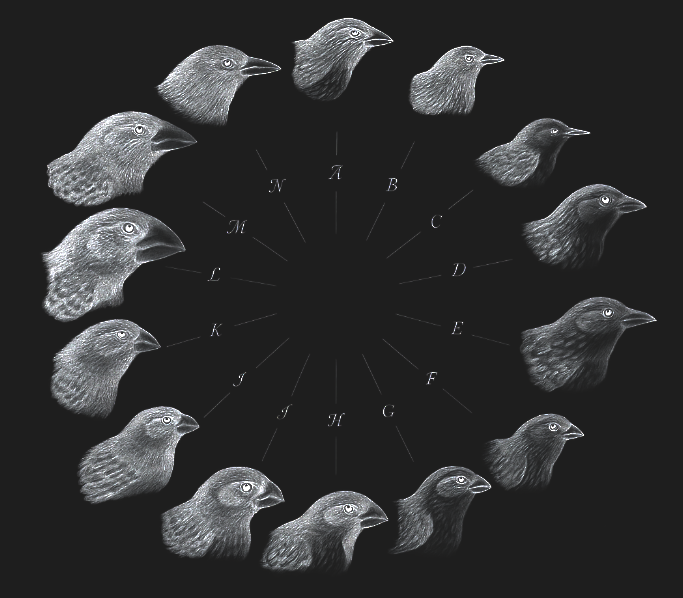
In 1835, Charles Darwin arrived at the Galápagos Islands. Among the many species he observed were small birds that would later become known as Darwin's finches. At first glance the birds appeared nearly identical. Yet their beaks varied dramatically from island to island.
Some were thick and strong, suited for cracking seeds. Others were long and narrow, adapted for extracting insects from bark. Others were slender and pointed, designed for feeding on cactus flowers. These differences were not aesthetic variations. Each beak shape reflected a functional response to the environment in which the bird lived.
The birds had not been intentionally designed to look different. They had evolved in response to the specific ecological conditions of each island. Food sources, vegetation, climate, and competition between species created different survival requirements. From those pressures emerged different functions. From those functions emerged different forms. The beak was not aesthetic. It was a consequence of context.
CONTEXT AS AN ECOSYSTEM
The finch does not exist in isolation. It exists within a broader system of relationships — climate, food sources, competition, terrain, and countless other variables. Its form is the outcome of how effectively it responds to all of them simultaneously.

Every branch, every angle, every proportion of this tree is the direct consequence of its environment — wind direction, soil composition, light availability, competition from surrounding growth. Its form was not chosen. It was determined by the full structure of conditions surrounding it. Nothing is arbitrary. Nothing is extra.
Business operates in much the same way. Products and services exist within ecosystems defined by market demand, technological capability, cultural expectations, economic realities, and the internal strengths of the organizations producing them. No product succeeds purely because of its form. It succeeds because it fits the conditions surrounding it.
Innovation emerges when the forces shaping this ecosystem are understood and aligned. When the environment surrounding a challenge becomes clear, the path toward a coherent solution begins to emerge naturally.
CONTEXT AS STRUCTURE
Every outcome has a source. A form that appears inevitable was produced by a structure that existed long before it took shape. The beak of the finch was not drawn. It was determined — by climate, predators, food sources, terrain, competition, and behavioral pressures interacting over time. The bird is the output. The conditions are the code.
To understand how the outcome emerges, it becomes useful to read that code directly — to visualize the surrounding context rather than the outcome it produces.
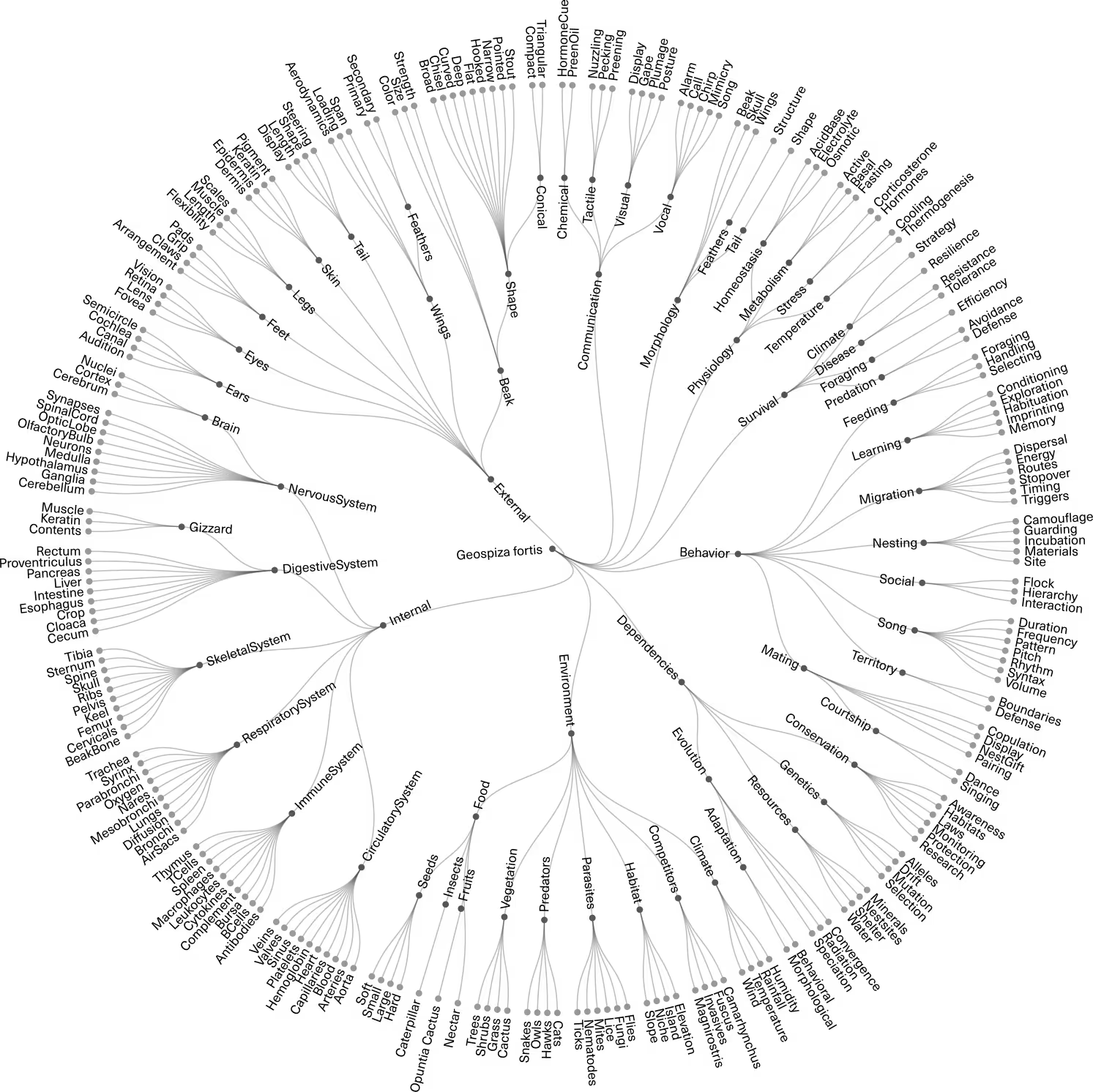
This diagram is not a picture of a finch. It is the context map of a finch — the source code of this specific organism in this specific environment. Each branch maps a force governing the conditions in which Geospiza fortis must survive. Together these forces define a precise set of functional requirements. From those requirements the form of the beak follows — not as a creative choice but as a logical consequence.
Every product, service, and strategy has a context map of the same kind. Market forces, cultural signals, human behaviors, organizational capabilities, technological constraints — these are not background conditions. They are the active variables that determine what the solution must become. What we eventually observe in the world is simply the output of that map, well read or poorly read.
Context-Based Design is the discipline of reading it before drawing a single line.
Form follows function. Function follows context.
Fidelity
Understanding a context is not a binary condition. It exists on a spectrum.
Consider the difference between an amateur golfer and a professional. An amateur might account for distance, wind, and slope before taking a shot. A professional perceives far more: humidity, air density, temperature, ball compression, grass type, subtle variations in terrain, and body alignment.
The difference is not simply the number of variables considered. It is the fidelity with which the environment is understood.
Experienced designers operate in much the same way. They learn to perceive the broader systems surrounding a challenge — market dynamics, manufacturing realities, organizational constraints, consumer behavior, cultural context, and competitive forces. Where others see a brief, the contextual designer sees a field. The solution space narrows the more precisely that field is understood.
.svg)
.svg)
NOTHING EXTRA. NOTHING LESS.

Consider water. H₂O — two hydrogen atoms bonded to one oxygen atom. Every property water possesses depends on this exact molecular configuration. Its polarity, surface tension, and ability to dissolve substances all arise from this precise structure.
Change the structure slightly and the molecule becomes something else entirely. Add one additional oxygen atom and the compound becomes hydrogen peroxide. Something drinkable becomes toxic. The difference is only one atom, yet the consequences are categorical.
The principle scales.
Consider aspirin. Nine carbons, eight hydrogens, four oxygens — arranged with absolute precision. Its ability to reduce fever, relieve pain, and thin the blood all emerge from this exact configuration. Early synthesis errors misplaced the acetyl group. The result caused severe gastric bleeding. Same atoms. One bond in the wrong position. Categorical consequence.
Effective systems are not defined by simplicity alone. They are defined by precision. Every complex system contains a moment of equilibrium where each element is necessary and nothing is superfluous. Remove one component and the system fails. Add one unnecessary component and the system becomes distorted.
When context is understood with sufficient clarity, solutions reach that point of calibration — nothing extra, nothing less.
THE QUESTION BEFORE THE BRIEF
Context-Based Design begins before the brief is written. Before a solution is imagined. The designer examines the environment in which the problem exists — market dynamics, technological constraints, cultural signals, organizational capabilities, economic realities. When these conditions are understood clearly, the brief that emerges is already aligned with what the solution must become.
Most design processes begin somewhere else. By the time work starts, the most consequential decisions have already been made. Quietly. Without scrutiny. Embedded in assumptions about the market, the organization, the technology, or the behavior of the people the solution is meant to serve. The brief inherits these assumptions. The designer inherits the brief.
The result is frequently a solution that addresses symptoms rather than underlying conditions. It may be well-executed. It may even be beautiful. But if the conditions that produced the brief were never examined, the solution is answering the wrong question with great precision.
Not the brief. Not the objective. The context. Define it with sufficient precision and the right solution begins to reveal itself.
DESIGNING THE CONTEXT
Context-Based Design begins by defining the field — not the solution.
Before a concept is generated, before a brief is accepted, the designer maps the full system of forces surrounding the challenge. Each variable is examined not in isolation but in relation to the others — because it is the relationship between forces, not any single factor, that determines what the optimal outcome must be.
This mapping is organized around three interdependent pillars.
The first is culture — the broader environment in which the solution must exist. Market conditions, competitive dynamics, technological shifts, and the signals of the moment all define what is possible and what is necessary. Culture determines the window through which a solution must pass.
The second is human need — the specific behaviors, desires, and frictions the solution must address. Not the stated need, and not the assumed need, but the underlying condition that generates both. When human need is understood precisely, the solution becomes obvious. When it is misread, even the most well-crafted response lands in the wrong place.
The third is organizational capability — what the organization can credibly deliver given its resources, expertise, and constraints. Ambition must be calibrated against reality. The most contextually aware solution is worthless if the organization cannot execute it with integrity.
These three pillars interact. No single force determines the outcome alone. The solution that emerges from understanding all three simultaneously — and the relationships between them — is the one most likely to fit the world it enters.
Flowing from these pillars are the governors: the more specific variables that shape and calibrate the initiative in detail. Technology constraints. Cultural timing. Competitive positioning. Regulatory environment. User behavior patterns. Distribution realities. Each governor refines the solution space further, until what initially appeared to be an open-ended creative challenge resolves into something precise — a functional requirement with a shape.
This is not a creative process in the conventional sense. It is an analytical one. The designer is not searching for inspiration. They are reading the structure of the situation until the right response becomes clear. At that point the designer's role shifts from inventor to interpreter. The solution is not invented. It is revealed.
The Governors
The goal of Context-Based Design is not creativity for its own sake. It is fit.
A solution that fits its context doesn't just appeal to its market — it belongs there. It meets the customer's reality at precisely the right point. It operates within the organization's actual capabilities. It arrives at the right moment in the competitive landscape. When all of these forces align, the outcome feels less like an invention and more like an inevitability.
When market opportunity and organizational capability are understood together — when the full structure of conditions is mapped and the solution designed to satisfy that structure precisely — something shifts. Decisions become easier to make. Resources align naturally. The solution requires less explanation because it already fits the world it enters.
That quality of fit is not luck. It is the result of a process that began before a single concept was drawn.
ALIGNMENT
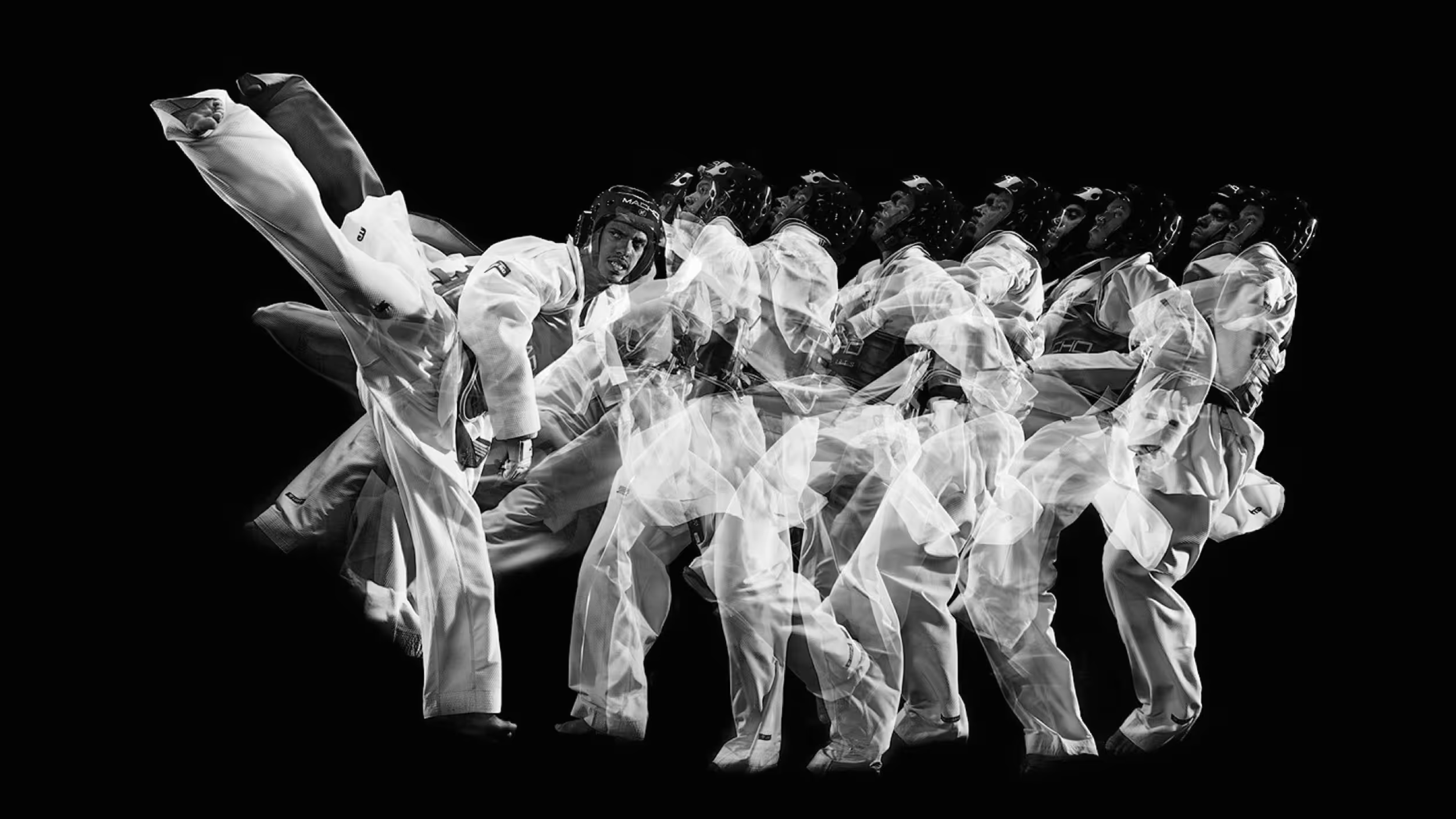
A taekwondo technique executed with complete precision leaves nothing to interpretation. Every position in the sequence is exactly where it must be — the result of conditions understood, forces calibrated, movement aligned to a single purpose.
The goal of Context-Based Design is not creativity for its own sake. It is fit.
A solution that fits its context doesn't just appeal to its market — it belongs there. It meets the customer's reality at precisely the right point. It operates within the organization's actual capabilities. It arrives at the right moment in the competitive landscape. When all of these forces align, the outcome feels less like an invention and more like an inevitability.
When market opportunity and organizational capability are understood together — when the full structure of conditions is mapped and the solution designed to satisfy that structure precisely — something shifts. Decisions become easier to make. Resources align naturally. The solution requires less explanation because it already fits the world it enters.
That quality of fit is not luck. It is the result of a process that began before a single concept was drawn.
FIT
Every market is an ecosystem. Within it, multiple solutions compete for the same space — each attempting to satisfy the same underlying conditions, address the same human need, operate within the same cultural moment.
The solution that fits most precisely wins. Not because it is the most creative. Not because it is the most ambitious. But because it satisfies the conditions of its environment more completely than anything else in the field. It belongs where it lands. The market does not need to be convinced. It simply selects.
This is how fit operates in nature. An organism that is precisely adapted to its environment survives. One that is misaligned — even slightly — yields ground to a competitor that fits more completely. The selection is not arbitrary. It is structural. The environment determines which solutions persist and which do not.
Business operates under the same pressure. A product that fits its context — the cultural moment, the human need, the organizational capability that produced it — requires less explanation, less marketing, less effort to sustain. It finds its audience because it was built for them with precision. Adoption is not forced. It is earned by fit.
The organizations that understand this stop asking how to make their solutions more compelling. They start asking how to make them more precisely aligned. The answer to both questions is the same. It begins with context.
The central idea is simple. Form follows function. Function follows context. When context is understood with sufficient fidelity, the nature of the solution becomes clear. Function emerges as a direct response to the conditions that define success. Form then becomes the natural expression of that response. In this sense, design is not the invention of something new. It is the act of revealing the solution that already fits the situation.
The discipline that makes this possible is not creative in the conventional sense. It is analytical. It begins before the brief, before the concept, before any solution is imagined. It maps the full structure of conditions surrounding a challenge — culture, human need, organizational capability — and reads that structure until the right response becomes clear. The designer's role in this process is not to invent. It is to interpret.
Organizations that learn to define context with rigor gain a significant and compounding advantage. Decisions become clearer. Resources align more effectively. Solutions require less explanation because they already fit the world they enter. Outcomes appear less accidental and more inevitable. Design, at its best, does not decorate a solution. It defines the conditions from which the right solution can emerge.
This page introduces the principles of Context-Based Design, a framework developed by Todd Bracher that examines how products, services, and strategies emerge from the conditions in which they must succeed. The approach focuses on understanding the broader systems surrounding a challenge — including market forces, organizational capabilities, technological realities, and cultural context — in order to develop solutions that are precisely aligned with their environment.
The ideas presented here are explored in greater depth in the book Design in Context: A Framework for Strategic Differentiation, which outlines the methodology and underlying principles of this approach.
Todd Bracher is an industrial designer and strategic advisor whose work explores how design can align human behavior, business strategy, and environmental systems. Over the past two decades he has collaborated with global organizations to develop products and innovation strategies grounded in contextual understanding.
Further writing and related work can be found at
www.toddbracher.com